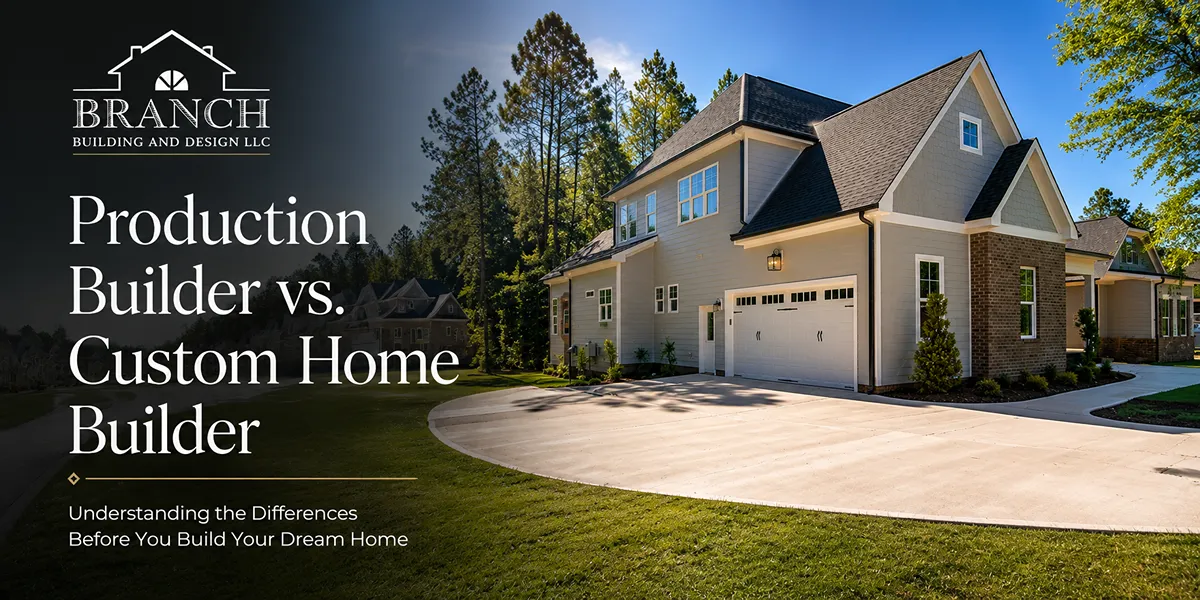
Production Builder vs. Custom Home Builder | Which Is Right for You?
Understanding the Differences Before You Build Your Dream Home
If you're planning to build a new home, one of the biggest decisions you'll make isn't choosing a floor plan or selecting finishes—it's deciding what type of builder is the right fit for your project.
Many people assume all home builders operate the same way. After all, they're all building houses, right?
Not exactly.
The experience of building with a production builder is very different from building with a custom home builder. From the level of personalization to where you can build, the design process, the quality of materials, and even how decisions are made, the two approaches serve different types of homeowners.
Neither option is inherently better than the other. The right choice depends on your goals, your budget, your timeline, and the kind of home you envision for your family.
If you're looking for a move-in-ready home within an established community, a production builder may be the right fit. If you've purchased land, want to build on your own lot, or dream of creating a home that's designed specifically around your lifestyle, working with a custom home builder may provide the flexibility you're looking for.
In this guide, we'll compare production builders and custom home builders, explain the advantages of each approach, and help you determine which option best aligns with your vision for your future home.
What Is a Production Builder?
Production builders construct homes using a collection of pre-designed floor plans that are built repeatedly across multiple homesites within a planned community or subdivision.
Rather than designing every home from scratch, production builders focus on creating an efficient building process by offering buyers a selection of proven layouts, exterior styles, and finish packages. Because the planning, engineering, and construction methods have already been refined, production builders are often able to build homes more quickly and at a larger scale.
Buyers typically begin by selecting a community, choosing one of several available floor plans, and then personalizing certain features through a design center. Depending on the builder, these choices may include cabinetry, flooring, countertops, paint colors, lighting, and other finish selections.
The overall structure of the home, however, generally remains the same.
This streamlined approach appeals to many homeowners because it simplifies the decision-making process while providing a predictable path from contract to move-in.
Advantages of Working With a Production Builder
Production builders offer several benefits, particularly for buyers who value convenience and efficiency.
Some advantages include:
-
- Faster construction timelines due to standardized building processes.
- Established neighborhoods with completed infrastructure and community amenities.
- Predictable pricing based on pre-designed floor plans.
- Simplified design selections through curated finish packages.
- Proven home layouts that have been built and refined many times.
For many families, this approach provides an excellent balance between personalization and convenience.
What Is a Custom Home Builder?
A custom home builder takes a fundamentally different approach.
Instead of asking you to choose from a handful of predetermined floor plans, a custom builder begins with your vision.
Every family lives differently. Some homeowners prioritize entertaining, while others need dedicated home offices, multigenerational living spaces, expansive outdoor areas, or garages designed for hobbies and recreational vehicles. A custom home builder works with you to create a home that reflects those priorities rather than asking you to adapt your lifestyle to an existing design.
In many cases, custom builders also specialize in building on privately owned land. Whether you've already purchased property or are still searching for the right homesite, your builder can help evaluate the lot, identify opportunities and challenges, and design a home that takes full advantage of the property's natural features.
At Branch Building & Design, we believe the best custom homes are those that feel like they belong on the land they're built upon. Rather than forcing a standard floor plan onto every property, we design homes that respond to the site's topography, views, natural light, privacy, and the way each family intends to live.
The result is a home that's truly one of a kind—not because it's extravagant, but because it was designed specifically for you.
Advantages of Working With a Custom Home Builder
Building a custom home offers a level of flexibility that simply isn't possible with most production homes.
Some of the biggest advantages include:
-
- A home designed specifically around your family's lifestyle.
- Greater flexibility in floor plans, layouts, and architectural style.
- The ability to build on your own lot.
- Personalized material and finish selections.
- Greater collaboration throughout the design and construction process.
- A stronger relationship with your builder from initial planning through completion.
For homeowners who view their home as a long-term investment, custom building offers the opportunity to create spaces that continue to serve their family for years to come.
The Biggest Difference: Personalization
The most significant distinction between production builders and custom home builders comes down to one word:
Personalization.
Production builders begin with an established plan and allow buyers to personalize certain features within that framework.
Custom home builders begin with the homeowner.
Instead of asking which floor plan you'd like to choose, the conversation often starts with questions like:
-
- How does your family spend time together?
- Do you work from home?
- Do you love to entertain?
- How important is outdoor living?
- Are you planning to stay in this home for decades?
- Do you anticipate aging in place?
- What features would make everyday life easier?
Those conversations become the foundation for every design decision that follows.
The goal isn't simply to build a beautiful house—it's to create a home that supports the way your family lives today while remaining functional as your needs evolve in the future.
When every room has a purpose and every detail is intentional, your home becomes more than a collection of square footage. It becomes a reflection of your lifestyle.
Comparing Production Builders and Custom Home Builders
While both production builders and custom home builders ultimately deliver a completed home, the experience—and the end result—can be very different.
Understanding these differences can help you choose the approach that best aligns with your family's priorities, budget, and long-term goals.
| Feature | Production Builder | Custom Home Builder |
|---|---|---|
| Home Design | Choose from pre-designed floor plans | Designed specifically around your lifestyle |
| Homesite | Builder-owned communities | Your lot or a lot you purchase |
| Customization | Limited structural changes | Extensive design flexibility |
| Architectural Style | Predefined elevations | Tailored to your preferences |
| Material Selections | Curated packages | Wide variety of finishes and products |
| Builder Relationship | Sales consultant and construction team | Direct collaboration with your builder |
| Construction Process | Standardized and repeatable | Personalized for your project |
| Best For | Buyers seeking convenience and efficiency | Homeowners wanting a one-of-a-kind home |
Neither approach is inherently right or wrong. The better choice depends on what matters most to you.
If your priority is moving into a thoughtfully planned neighborhood with an established floor plan and streamlined decision-making process, a production builder may offer exactly what you're looking for.
If your priority is creating a home that's tailored to your family, your property, and the way you live, a custom builder provides significantly more flexibility throughout the process.
Is a Custom Home More Expensive?
One of the biggest misconceptions about custom homes is that they're always dramatically more expensive than production homes.
The reality is more nuanced.
Production builders often benefit from economies of scale. By constructing the same floor plans repeatedly, purchasing materials in large quantities, and building entire communities at once, they can streamline costs and improve efficiency.
Custom homes are priced based on the unique characteristics of each individual project.
Several factors influence the overall investment, including:
-
- The size and complexity of the home.
- The location and condition of the homesite.
- Architectural details.
- Material selections.
- Site preparation requirements.
- Outdoor living spaces.
- Specialized features and finishes.
Because every custom home is different, there isn't a standard price per square foot that accurately represents every project.
More importantly, custom building allows you to decide where your investment goes.
Instead of paying for features you may never use, you can prioritize the spaces that matter most to your family—whether that's a larger kitchen, a luxurious primary suite, a dedicated home office, an oversized garage, or expansive outdoor living areas.
For many homeowners, that level of control provides greater long-term value than simply choosing the lowest initial price.
Flexibility Throughout the Design Process
One of the greatest advantages of building a custom home is the flexibility to create spaces that genuinely support your lifestyle.
Rather than adapting your family's routines to fit an existing floor plan, your home is designed around the way you already live.
Maybe you enjoy hosting family gatherings and want an open-concept kitchen with a large walk-in pantry.
Perhaps you work remotely and need a quiet office with plenty of natural light.
Maybe you're planning for aging parents, adult children returning home, or simply want additional flexibility for the future.
These aren't upgrades—they're design decisions.
A custom builder works with you throughout the planning process to understand how your family functions and translate those conversations into a home that's both beautiful and practical.
The result is a home that feels intentional because every room serves a purpose.
Building on Your Own Lot
For many homeowners, the dream isn't simply building a new home—it's building that home on a piece of property they've carefully chosen.
Whether it's a wooded homesite, several acres in the countryside, or a lot tucked into an established neighborhood, building on your own land opens the door to possibilities that production builders often can't offer.
Designing around the property allows you to take advantage of:
-
- Scenic views.
- Mature trees.
- Natural sunlight.
- Existing topography.
- Outdoor living opportunities.
- Privacy.
- Future additions.
Instead of trying to make every lot fit the same home, a custom builder designs the home to complement the land.
That thoughtful approach often creates a stronger connection between the home and its surroundings while making better use of the property's natural features.
If you're considering building on privately owned land, it's also beneficial to involve your builder before purchasing the property. Early site evaluations can identify grading requirements, utility access, soil conditions, and other factors that may influence your home's design and overall budget.
Quality Is About More Than Materials
When people think about quality, they often picture premium countertops, hardwood flooring, or high-end appliances.
While those finishes certainly contribute to the overall appearance of a home, true quality begins long before the cabinets are installed.
It starts with thoughtful planning.
A well-designed custom home considers how spaces flow together, how natural light moves through the house, how the home fits the property, and how the family will use each room for years to come.
Attention to detail during the planning and construction process often has a greater impact on long-term satisfaction than any individual finish selection.
Quality also comes from collaboration.
Working closely with your builder throughout the project allows questions to be answered quickly, design decisions to be refined, and small details to receive the attention they deserve.
It's this combination of craftsmanship, communication, and thoughtful design that ultimately creates a home built to stand the test of time.
Which Builder Is Right for You?
By now, you've probably realized that choosing between a production builder and a custom home builder isn't about determining which one is "better." It's about deciding which approach best matches your goals, priorities, and vision for your future home.
For some families, the simplicity and predictability of a production builder make perfect sense. For others, the flexibility and personalization of a custom home are worth the additional planning involved.
The key is understanding what matters most to you before beginning the building process.
A Production Builder May Be the Right Choice If...
A production builder is often a great fit for buyers who value convenience, efficiency, and a streamlined home-buying experience.
You may prefer a production builder if you:
-
- Want to move into a home as quickly as possible.
- Prefer purchasing within a planned neighborhood or master-planned community.
- Are comfortable choosing from a selection of existing floor plans.
- Don't require significant structural changes or customization.
- Appreciate a simplified design process with curated finish selections.
For many homeowners, this approach offers a straightforward path to homeownership with fewer design decisions and a well-established construction process.
A Custom Home Builder May Be the Right Choice If...
If you've spent years imagining your dream home, purchasing an existing floor plan may leave you wishing you had more flexibility.
A custom home builder may be the better choice if you:
-
- Own land or plan to build on your own lot.
- Want a home designed specifically around your family's lifestyle.
- Value craftsmanship and personalized attention throughout the project.
- Need unique spaces such as a home office, workshop, bonus room, or multigenerational suite.
- Plan to stay in your home for many years and want it to evolve with your family's needs.
- Appreciate having greater input throughout the design and construction process.
Rather than asking you to fit your life into a predetermined layout, a custom home allows the design to reflect the way you actually live.
Why Many Families Choose to Build Custom
For many homeowners, building a custom home isn't about creating something extravagant.
It's about creating something intentional.
Your family's routines, hobbies, priorities, and future plans are unique. A custom home allows those factors to influence every design decision—from the overall layout to the smallest architectural details.
Maybe your mornings revolve around a spacious kitchen where everyone naturally gathers before work and school.
Maybe weekends are spent entertaining friends on a covered outdoor living space overlooking your property.
Maybe you work from home and need a quiet office that's separated from the busiest parts of the house.
Or perhaps you're thinking decades ahead and want wider hallways, a main-floor primary suite, or flexible living spaces that allow you to comfortably age in place.
These aren't simply upgrades on a pricing sheet—they're thoughtful design decisions that improve the way you live every day.
A well-designed custom home should feel like it belongs to your family because it was created specifically for your family.
The Value of a Collaborative Building Experience
One of the most rewarding aspects of building a custom home is the relationship that develops throughout the process.
Rather than selecting options from a catalog, you're working alongside a builder who understands your goals and helps guide important decisions from the earliest planning stages through the final walkthrough.
That collaboration often leads to better outcomes because questions are addressed early, challenges are solved proactively, and every major decision is made with your long-term goals in mind.
At Branch Building & Design, we believe communication is just as important as craftsmanship.
Whether we're evaluating a homesite, refining a floor plan, discussing finishes, or navigating construction, our goal is to make the experience enjoyable, transparent, and personalized from beginning to end.
Building a custom home should feel exciting not overwhelming and having the right builder by your side makes all the difference.
Frequently Asked Questions
Is a custom home always more expensive than a production home?
Not necessarily. Production builders often benefit from building the same floor plans repeatedly, which can improve efficiency. Custom homes are priced based on factors such as the home's design, site conditions, materials, and level of personalization. Depending on your priorities, a custom home can provide exceptional long-term value by allowing you to invest in the features that matter most.
Can I build a custom home on my own lot?
Yes. Many custom home builders specialize in building on privately owned land. If you're still searching for property, involving your builder before purchasing a lot can help identify potential opportunities and challenges before you commit.
How long does it take to build a custom home?
Every project is different, but most custom homes take longer than production homes because each one is uniquely designed and built. Factors such as permitting, site preparation, weather, material availability, and the home's complexity all influence the timeline.
Can I make changes during construction?
Minor changes are often possible, although larger design changes may affect both the project schedule and overall budget. Making as many decisions as possible during the design phase helps keep construction moving efficiently.
Do I need architectural plans before contacting a custom builder?
No. Many homeowners contact a custom builder before plans have been created. In fact, involving your builder early often leads to a more efficient design process by ensuring the home's layout, budget, and property all work together from the very beginning.
Build the Home That Fits Your Life
Whether you're considering a production builder or exploring the possibilities of building a fully custom home, the most important decision is choosing the approach that aligns with your family's goals.
If you're looking for a streamlined process with a predetermined floor plan, a production builder may be the right fit.
If you want a home that's thoughtfully designed around your lifestyle, your property, and the way your family lives today—and for years to come—a custom home builder offers a level of flexibility that's difficult to match.
At Branch Building & Design, we work with homeowners throughout Wake County and the Triangle to create homes that are as functional as they are beautiful. From evaluating homesites and developing custom floor plans to guiding you through every phase of construction, we're committed to making your home-building experience enjoyable, transparent, and tailored to your vision.
If you're ready to explore what's possible, we'd love to hear about your ideas and help you take the next step toward building a home that's uniquely yours.
Internal Linking Opportunities
This article should naturally connect to several cornerstone pages and guides throughout the website, including:
- Build on Your Lot – when discussing building on privately owned land.
- Custom Home Design – when explaining personalized floor plans and lifestyle-focused design.
- Our Process – when describing the collaborative design-build experience.
- Should You Buy Land Before Choosing a Custom Home Builder? – when encouraging early builder involvement.
- How Long Does It Take to Build a Custom Home? – when discussing construction timelines.
- Custom Home Cost Guide – when comparing pricing and project budgeting.
- Apex Custom Home Case Study – as a real-world example of a custom home designed around unique site conditions.
This article complements your existing content library by helping homeowners answer one of the biggest early-stage buying questions while reinforcing Branch Building & Design's expertise throughout every step of the custom home journey.